
A size label and a measured size answer different questions
Nominal size is the trade label used to identify lumber. Actual size is what you measure on the piece. A dry surfaced softwood 2×4 commonly has a 1.5-inch by 3.5-inch cross section. Use the label to find the product; use the measured dimensions when volume or fit matters.
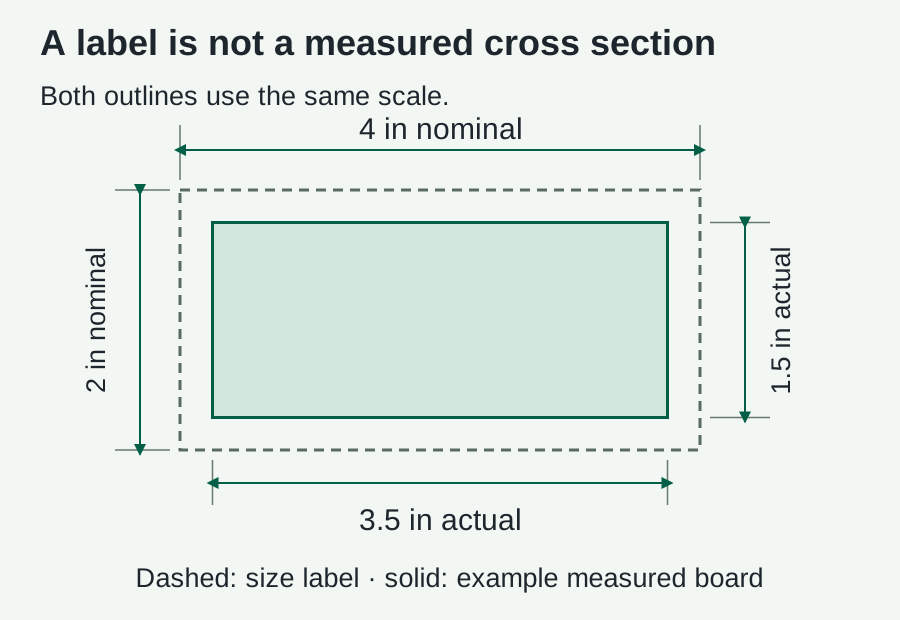
Drying changes dimensions, and surfacing removes material to make finished faces and edges. The standard’s size categories account for those differences. They are not a universal subtraction rule: a nominal 1×6 and a nominal 2×8 do not lose the same amount in every dimension.
Do not infer a board’s manufacturing history, moisture content or exact present size from the label alone. Product type and condition matter, and wood can change size after manufacture.
Reference chart for common dry surfaced softwood sizes
The chart shows selected minimum dry dressed sizes for ordinary softwood boards and dimension lumber under 5 inches nominal thickness. “Dressed” means machine surfaced. The dry-size reference is 19% moisture content; dry grading provisions use 19% or less at grade marking. This is not a measurement of every board sold under these labels.
Scroll the table horizontally to see all columns.
| Nominal label | Dry dressed thickness | Dry dressed width | Decimal input: T × W |
|---|---|---|---|
| 1×2 | 3/4 | 1-1/2 | 0.75 × 1.5 |
| 1×4 | 3/4 | 3-1/2 | 0.75 × 3.5 |
| 1×6 | 3/4 | 5-1/2 | 0.75 × 5.5 |
| 1×8 | 3/4 | 7-1/4 | 0.75 × 7.25 |
| 1×10 | 3/4 | 9-1/4 | 0.75 × 9.25 |
| 1×12 | 3/4 | 11-1/4 | 0.75 × 11.25 |
| 2×2 | 1-1/2 | 1-1/2 | 1.5 × 1.5 |
| 2×4 | 1-1/2 | 3-1/2 | 1.5 × 3.5 |
| 2×6 | 1-1/2 | 5-1/2 | 1.5 × 5.5 |
| 2×8 | 1-1/2 | 7-1/4 | 1.5 × 7.25 |
| 2×10 | 1-1/2 | 9-1/4 | 1.5 × 9.25 |
| 2×12 | 1-1/2 | 11-1/4 | 1.5 × 11.25 |
| 4×4 | 3-1/2 | 3-1/2 | 3.5 × 3.5 |
Use the table to understand the product category, then measure the stock for your job. Green lumber, rough-sawn material, hardwood thickness designations and worked profiles such as tongue-and-groove boards need their own size information. This chart does not provide those dimensions.
Treat length separately. The reductions in thickness and width do not imply an identical reduction in advertised length. For physical volume, enter measured length. For a trade tally, confirm the seller’s stated length convention.
Choose inputs from the task, not just the label
Scroll the table horizontally to see all columns.
| Task | Use | Why |
|---|---|---|
| Find physical wood volume | Measured thickness, width and length | A nominal label does not describe the full physical cross section. |
| Check a nominal softwood tally | Nominal thickness and width, plus the stated tally length | The result is board measure, not cubic volume. |
| Make a joint or fit a part | Measurements of the actual mating pieces | A chart cannot confirm fit or allowance. |
| Plan a rough blank | Finished dimensions plus stated total milling allowances | The extra material belongs in each dimension once. |
| Buy for a geometric BF requirement | Actual stock dimensions and a geometric requirement | Required quantity and stock capacity must share a basis. |
| Price a seller’s BF quantity | The seller’s payable tally convention | Geometric volume may not be the invoiced quantity. |
- Read the product description and decide whether your task needs measured physical dimensions or a trade tally.
- For physical volume, measure thickness, width and length. Use decimal values such as 0.75 and 3.5 rather than typing fractions into numeric fields.
- In the board-foot tool, choose Board or matching parts, choose Input units, and select Actual or Nominal. Enter the appropriate dimension numbers yourself.
- Enter a positive whole board count, select Calculate and read the basis statement beneath the results. The page’s initial example is not your measurement.
Selecting Actual does not look up a 2×6 and replace it with 1.5×5.5. Selecting Nominal does not restore size labels from measured numbers. The basis control changes the interpretation statement; the Input units control converts the entered units.
Regular U.S. board mode takes thickness and width in inches and length in feet. Minimums are 0.001 inch and 0.001 foot. Metric mode takes millimeters and meters, with equivalent minimums of 0.0254 mm and 0.0003048 m. Counts must be whole numbers of at least one; a form accepting a small value is not a guarantee that you can measure it accurately.
Compare nominal board measure with geometric volume
The arithmetic stays the same on either basis. The dimension inputs determine what the answer means. Actual dimensions describe physical volume; nominal softwood dimensions produce a trade tally. The calculator cannot infer that the wrong numbers have been entered for the selected basis.
Calculate one 8-foot 2×4 on each basis
Inputs
- Board or matching parts; U.S. customary; one board 8 ft long.
- For nominal board measure, select Nominal and enter thickness 2 in and width 4 in.
- For physical volume, select Actual and enter measured thickness 1.5 in and width 3.5 in.
Calculation
- Nominal quantity: 2 × 4 × 8 ÷ 12 = 16/3 = 5.333333… nominal BF.
- Measured cross section: 1.5 × 3.5 = 5.25 in².
- Geometric quantity: 5.25 × 8 ÷ 12 = 3.5 BF.
- The numeric difference is 16/3 − 3.5 = 11/6 = 1.833333… BF. It reflects two measurement bases, not extra wood in the board.
Calculator results
- Nominal board measure
- 5.333 nominal BF
- Measured geometric quantity
- 3.5 BF
The calculator displays 5.333 BF or 3.5 BF and states the chosen basis beneath the result. In this article, “nominal BF” identifies the trade basis explicitly. You must change the dimension inputs as well as the basis selector.
Scroll the table horizontally to see all columns.
| Basis | Thickness × width | Length | Unrounded BF | Displayed BF |
|---|---|---|---|---|
| Nominal board measure | 2 in × 4 in | 8 ft | 16/3 | 5.333 |
| Actual geometric volume | 1.5 in × 3.5 in | 8 ft | 3.5 | 3.5 |
Do not describe the difference as missing material without specifying a manufacturing comparison. The example contrasts a label-based tally with the volume of the measured board. It does not calculate how much material a mill removed from a known original blank.
Use measured volume when converting to cubic feet
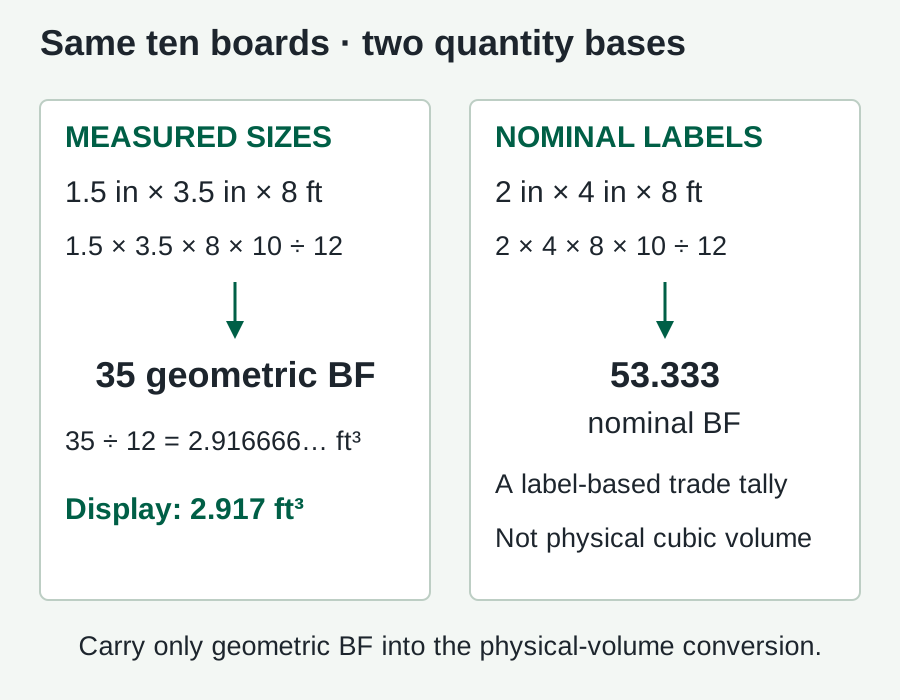
The relationship 12 geometric BF = 1 ft³ follows from 144 cubic inches per BF and 1,728 cubic inches per cubic foot. A nominal softwood tally is not a physical-volume quantity, so dividing it by 12 does not recover the surfaced boards’ actual volume.
Convert ten measured boards to physical volume
Inputs
- Ten boards, each measured 1.5 in × 3.5 in × 8 ft. Use Actual in the board-foot calculator.
- Then open Board feet to cubic feet, choose Actual and enter the geometric total of 35 BF.
Calculation
- Per board: 1.5 × 3.5 × 8 ÷ 12 = 3.5 geometric BF.
- Ten-board total: 3.5 × 10 = 35 geometric BF.
- Cubic volume: 35 ÷ 12 = 35/12 = 2.916666… ft³.
- Independent volume check: (1.5 × 3.5 × 96 × 10) ÷ 1,728 = 2.916666… ft³.
- Using the labels instead would give 2 × 4 × 8 × 10 ÷ 12 = 160/3 = 53.333333… nominal BF. That tally is not a physical-volume input.
Calculator results
- Measured ten-board total
- 35 BF
- Nominal ten-board tally
- 53.333 nominal BF
- Physical volume
- 2.917 ft³
The physical result displays as 2.917 ft³. The volume converter rejects the Nominal basis. The independent cubic-inch calculation confirms the measured-volume path without relying on a rounded BF total.
Match the purchasing requirement to the stock basis
The Boards to buy tool divides a BF requirement by the quantity in one stock board, then rounds up. Both quantities must describe the same basis. A geometric requirement cannot be divided by a nominal quantity per board to establish how much physical wood to buy.
- Open Boards to buy and choose Actual when the requirement describes physical volume.
- Enter Required quantity in geometric BF, then the measured stock thickness and width in inches and length in feet.
- Calculate. Read both Whole boards to buy and Purchase quantity. Check whether the stock also fits each required part.
- If you need a separate overage, include it in the requirement first. The board-count tool does not add one automatically.
Buy whole boards for a 21-geometric-BF requirement
Inputs
- Open Boards to buy. Select Actual; required quantity: 21 geometric BF before any additional overage.
- Available boards measure 1.5 in thick × 5.5 in wide × 8 ft long.
Calculation
- Quantity per measured board: 1.5 × 5.5 × 8 ÷ 12 = 5.5 BF.
- Board count before rounding: 21 ÷ 5.5 = 42/11 = 3.818181… boards.
- Round upward to 4 whole boards. Purchased quantity: 4 × 5.5 = 22 geometric BF.
- Check the smaller count: 3 × 5.5 = 16.5 geometric BF, which is short of the requirement.
Calculator results
- Whole boards to buy
- 4 boards
- Purchased geometric quantity
- 22 BF
The tool returns 4 boards and 22 BF. It adds no automatic waste allowance. This confirms quantity on one basis; you must still check whether each part fits the available widths and lengths.
Scroll the table horizontally to see all columns.
| Boards | Geometric BF per board | Total geometric BF | Compared with 21 BF |
|---|---|---|---|
| 3 | 5.5 | 16.5 | Short by 4.5 BF |
| 4 | 5.5 | 22 | Exceeds the requirement by 1 BF |
Enough volume is necessary but not sufficient. A part that needs a 3.75-inch finished width will not fit across a measured 3.5-inch board without changing the construction. More short boards cannot replace the uninterrupted length a long part requires. Review the layout before treating a purchase count as a complete cut list.
Separate measurement, display rounding and purchase rounding
Scroll the table horizontally to see all columns.
| Decision | How it works here | Example |
|---|---|---|
| Measurement | Enter the dimensions you measured, not a rounded nominal label. | 1.5 × 3.5 is not interchangeable with 2 × 4. |
| Numeric display | Intermediate values are retained; final numeric outputs show at most three decimal places. | 35/12 ft³ displays as 2.917 ft³. |
| Whole-board purchase | Round the required count upward. | 42/11 boards requires 4 boards. |
Use unrounded intermediate values for an independent calculation. A displayed result does not establish a seller’s rounding rule or a tolerance for a joint. Measure mating pieces directly and ask the seller how a payable tally is determined.
Questions about labels, hardwood and size changes
Is every 2×4 exactly 1.5 by 3.5 inches?
No. The chart gives minimum dry dressed reference sizes for a defined softwood product category. Moisture changes, product type and present condition can affect what you measure. Check the actual piece for volume and fit.
Can I subtract half an inch from every nominal size?
No. Compare the chart’s 1×6 and 2×8 entries: thickness and width reductions differ. Use the applicable product information rather than one subtraction rule, then measure the stock.
Does 4/4 hardwood mean 3/4-inch finished stock?
Not as a universal rule. Four quarters denotes a nominal 1-inch thickness. Rough thickness, surface treatment and the usable final thickness depend on the material and milling. The softwood chart does not determine them.
Does this chart establish structural capacity?
No. Dimensions alone do not establish load capacity, span, grade, installation suitability or code compliance. The chart supports measurement and quantity calculations, not structural design.
Identify by label, calculate on a stated basis
Use nominal labels to identify the product and measured dimensions to plan physical volume and fit. Record the basis with every BF total. Carry that same basis through quantity conversions and purchasing checks, and confirm any trade-tally convention before pricing lumber.